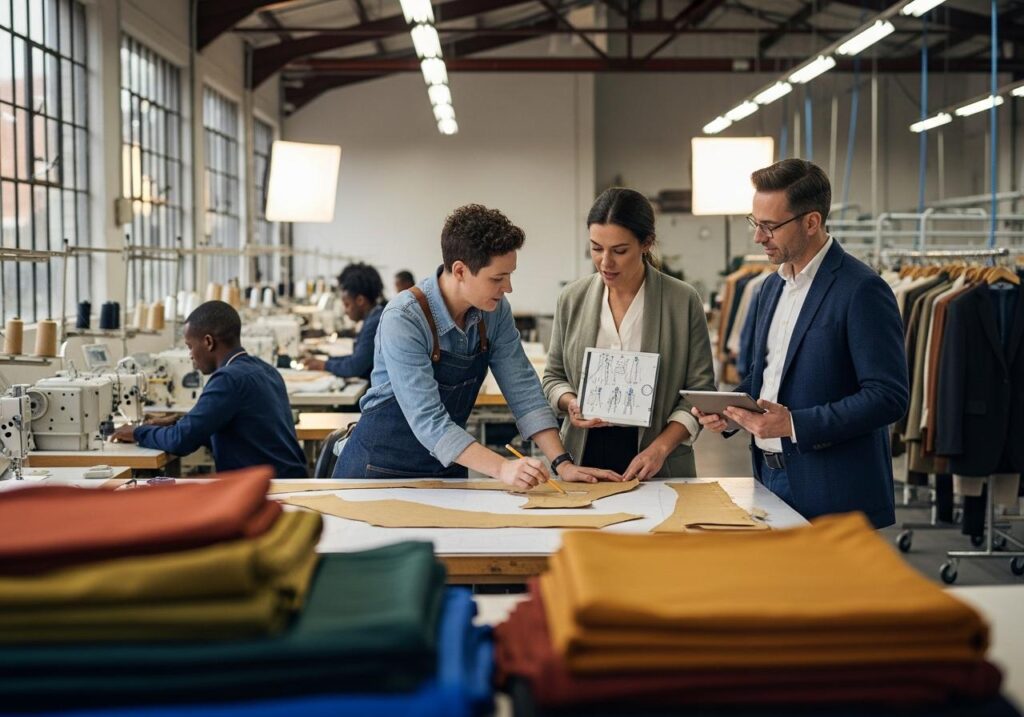
Launching a clothing line relies on finding the right manufacturing partner to ensure quality and precision. While Johannesburg is South Africa’s garment hub, navigating its many production options requires a strategic approach.
Drawing on years of industry experience, I’ve developed this framework to help you vet local manufacturers. This guide provides the actionable advice you need to turn your creative vision into a successful brand.
Why Johannesburg is a Hub for South African Fashion Production
Johannesburg’s status as a manufacturing hub isn’t accidental. The city offers a unique combination of logistical advantages, a skilled labour force, and access to both local and international markets.
- Logistical Superiority: Situated inland, Johannesburg is the country’s primary transport and logistics nexus. This ensures efficient distribution of finished goods across South Africa and simplifies the import of raw materials.
- Skilled Labour: The city has a long history of textile and garment production, resulting in a deep pool of experienced pattern makers, machinists, and quality controllers.
- Proximity to Markets: Being close to major retail head offices and a large consumer base allows for quicker feedback loops, faster delivery times, and a better understanding of local trends.
Understanding Manufacturing Models: CMT vs. FPP
Before you even start your search, you must understand the two primary production models. Choosing the wrong one is a common and expensive mistake for new entrepreneurs.
Cut, Make, Trim (CMT)
In a CMT model, you, the brand owner, are responsible for the majority of the pre-production work. You provide the manufacturer with:
- The graded patterns.
- The sourced fabric and trims (buttons, zips, labels).
- Detailed technical specifications (the “tech pack”).
The manufacturer’s job is strictly to cut the fabric, sew the garments, and add the trims. CMT is often more cost-effective per unit but requires you to have significant technical knowledge and a robust supply chain for materials. It’s best for established brands with in-house design and sourcing teams.
Full Production Package (FPP)
Full Production Package (FPP) is a comprehensive service where the manufacturer handles everything from pattern making and sourcing to final production based on your design. It simplifies the process by managing all logistics under one roof.
Ideal for startups and designers, FPP allows you to focus on creativity while we handle the technical complexity. At Pink Crystal Clothing, we specialize in this model, guiding your brand from initial sketch to retail-ready product.
Key Factors to Consider When Choosing a Manufacturer
Not all factories are created equal. Use these five factors as a checklist to evaluate potential partners in Johannesburg.
- Specialisation and Niche: Does the manufacturer have experience producing your type of clothing? A factory that excels at corporate wear may not have the right machinery or expertise for delicate swimwear or technical activewear.
- Minimum Order Quantities (MOQs): This is the smallest number of units a factory is willing to produce per style or colour. For new brands, finding a manufacturer with a low or flexible MOQ is essential to test the market without investing a huge amount of capital.
- Quality Control and Craftsmanship: Never compromise on quality. Ask about their inspection stages and how they handle defects. The best way to assess craftsmanship is to request a sample of your own design.
- Communication and Turnaround Times: Clear and consistent communication is non-negotiable. Ask for a standard turnaround time for sampling and for a full production run.
- Pricing and Transparency: Request a detailed cost breakdown including sampling, per-unit costs, and additional fees like pattern making or labelling.
A Shortlist of Clothing Manufacturers in Johannesburg
Here are a few Johannesburg-based manufacturers, each catering to different needs. This is a starting point for your research:
- Pink Crystal Clothing (Our Pick for Startups & Boutique Brands): We specialize in the Full Production Package (FPP) model. Our strengths are flexible MOQs, meticulous attention to detail, and a commitment to guiding clients from sketch to finished garment. We focus on womenswear, high-end casual wear, and custom apparel.
- The Clothing Co (For High-Volume & Corporate): Known for handling large-volume orders for corporate clients and major retailers. They have extensive capabilities in screen printing, embroidery, and producing uniforms.
- Imprint Apparel (Streetwear & Promotional): A niche player in the streetwear market, offering custom t-shirt printing, hoodie manufacturing, and cap branding.
The Step-by-Step Process of Working With a Manufacturer
Once you’ve shortlisted a few factories, follow this professional process:
- Prepare Your Tech Pack: This is the blueprint for your garment, including sketches, measurements, fabric composition, and trim details.
- Requesting a Quote and Sample: Select one manufacturer to produce a pre-production sample to test their quality and fit.
- Placing Your Production Order: After sample approval, issue a purchase order (PO) and typically pay a 50% deposit.
- Production and Quality Checks: The factory begins cutting and sewing. A good partner allows for quality checks during the process.
- Final Payment and Delivery: Once production is complete and final checks are done, pay the remaining balance and arrange for delivery.
Your Next Step
You now have a complete roadmap for finding the right clothing manufacturer in Johannesburg. The success of your clothing brand depends heavily on this foundational partnership.
If you are a startup or an established brand looking for a dedicated production partner that prioritises quality and communication, my team at Pink Crystal Clothing is here to help. Reach out to us today to discuss your vision!
FAQs
What is the average cost to manufacture clothing in Johannesburg?
Costs vary widely based on complexity and quantity. A simple t-shirt might cost R80 – R150 per unit, while a complex jacket could be over R800.
How do I find small-batch clothing manufacturers in Johannesburg?
Focus on manufacturers that advertise “low MOQs.” Companies like Pink Crystal Clothing specialise in this area.
What is a reasonable MOQ for a startup?
For a new brand, 30 to 100 units per style is reasonable to test the market without excess stock.
Do I need a registered business to work with a manufacturer?
Yes, most professional manufacturers require a registered business and a VAT number for formal production agreements.
How long does the manufacturing process take?
A typical production run usually takes 6 to 12 weeks from sample approval to delivery.